What Ballistic Calculator 2 is
Goal of this article: decide whether this application answers your question — and understand what kind of answer it gives — before you spend an evening typing loads into it.
Ballistic Calculator 2 is a free, open-source external-ballistics solver for Windows, Linux and macOS. You describe a projectile, a rifle, the air and the wind; it computes the trajectory and reports it as a table, a chart, a sight picture through your own reticle, and a summary of the shot’s useful ranges.
It is the successor to the WinForms Ballistic Calculator .NET, rewritten on Avalonia UI to be genuinely cross-platform rather than Windows-under-Wine. The trajectory mathematics is not ours: it comes from the BallisticCalculator library, which is developed and tested separately.
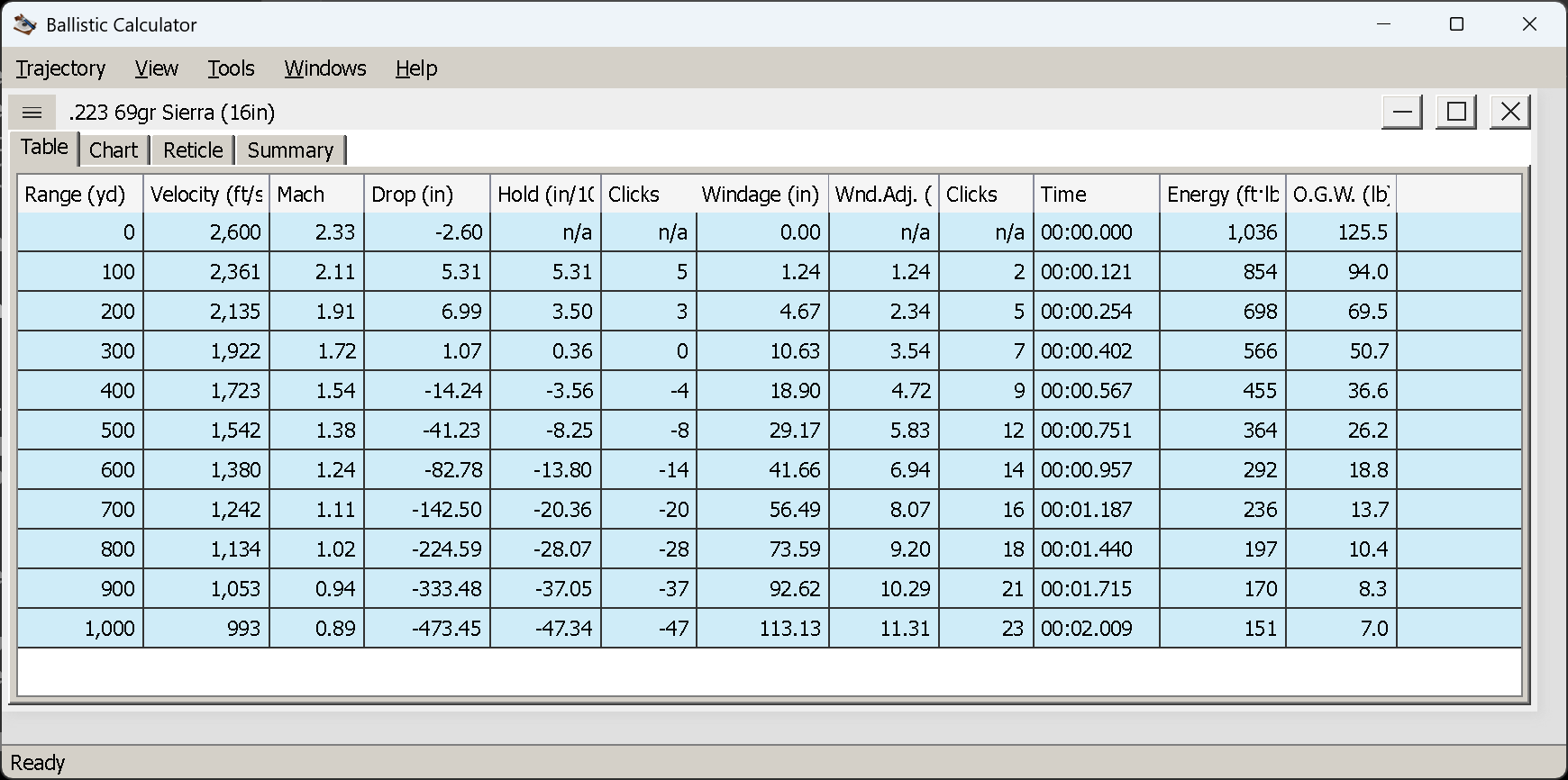
Drop, windage, clicks, energy and time of flight out to 1,000 yd — .223 69 gr Sierra, 300 yd zero. Click any image to open it full size.
What it is for
Accuracy comparable to commercial and 4DOF solvers. The engine integrates a 3DOF (point-mass) model, plus the correction terms that actually show up on paper — spin drift, crosswind aerodynamic jump and the Coriolis effect — and, more importantly, it accepts measured drag curves. That is where real accuracy comes from. A point-mass solver running the projectile’s own Cd curve tracks a 4DOF solver closely; what 4DOF adds is the projectile’s angular motion, not a better drag model. So rather than approximating angular motion, this application concentrates on letting you supply, or build, the actual curve.
Truly cross-platform. One codebase, native builds for Windows, Linux and macOS, no emulation layer. Every release ships both.
Android next. The calculation and domain layers carry no desktop UI dependencies, so a touch-first mobile application can be built on them. That work has not started.
What it does
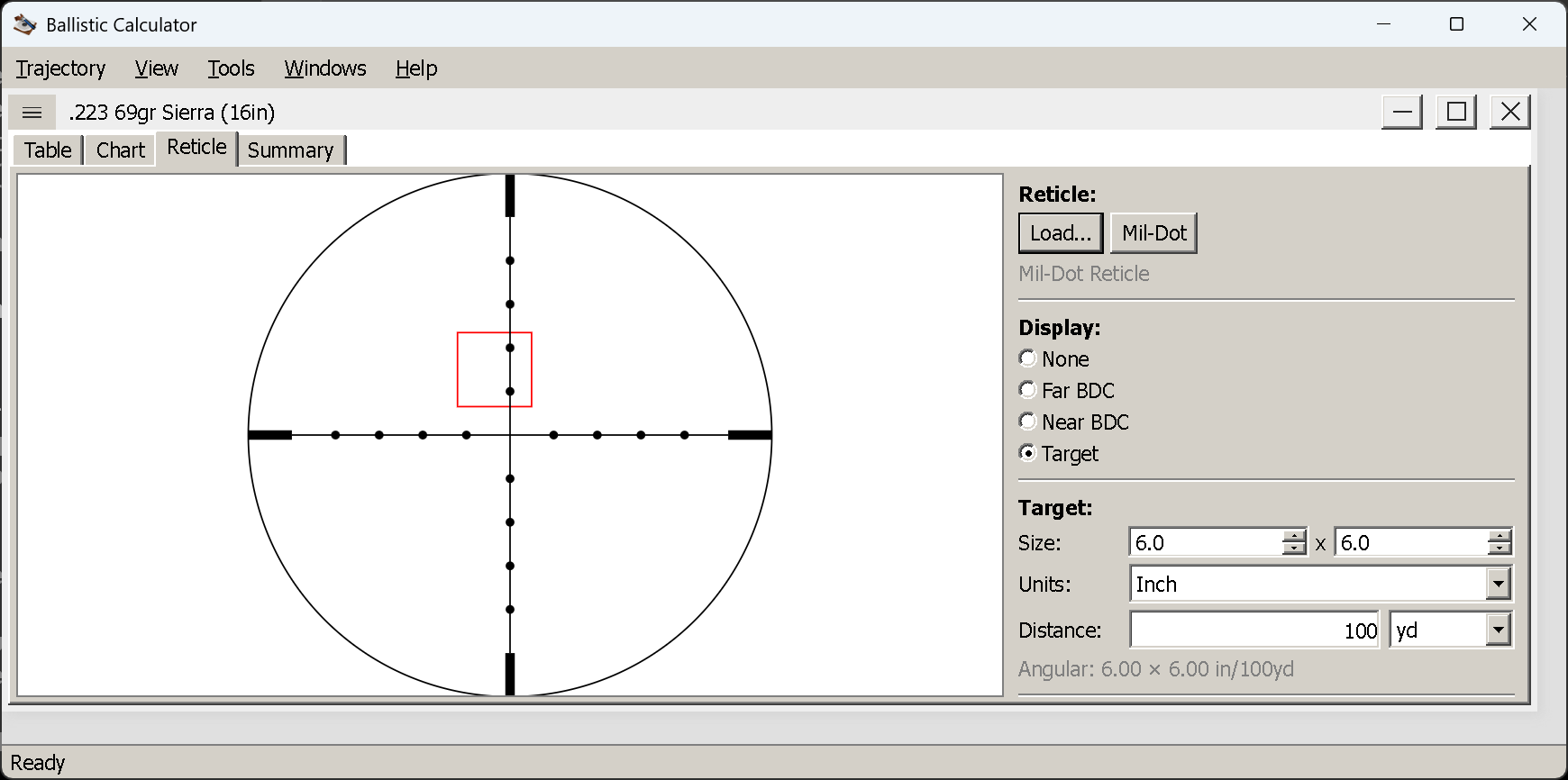 Sight picture |
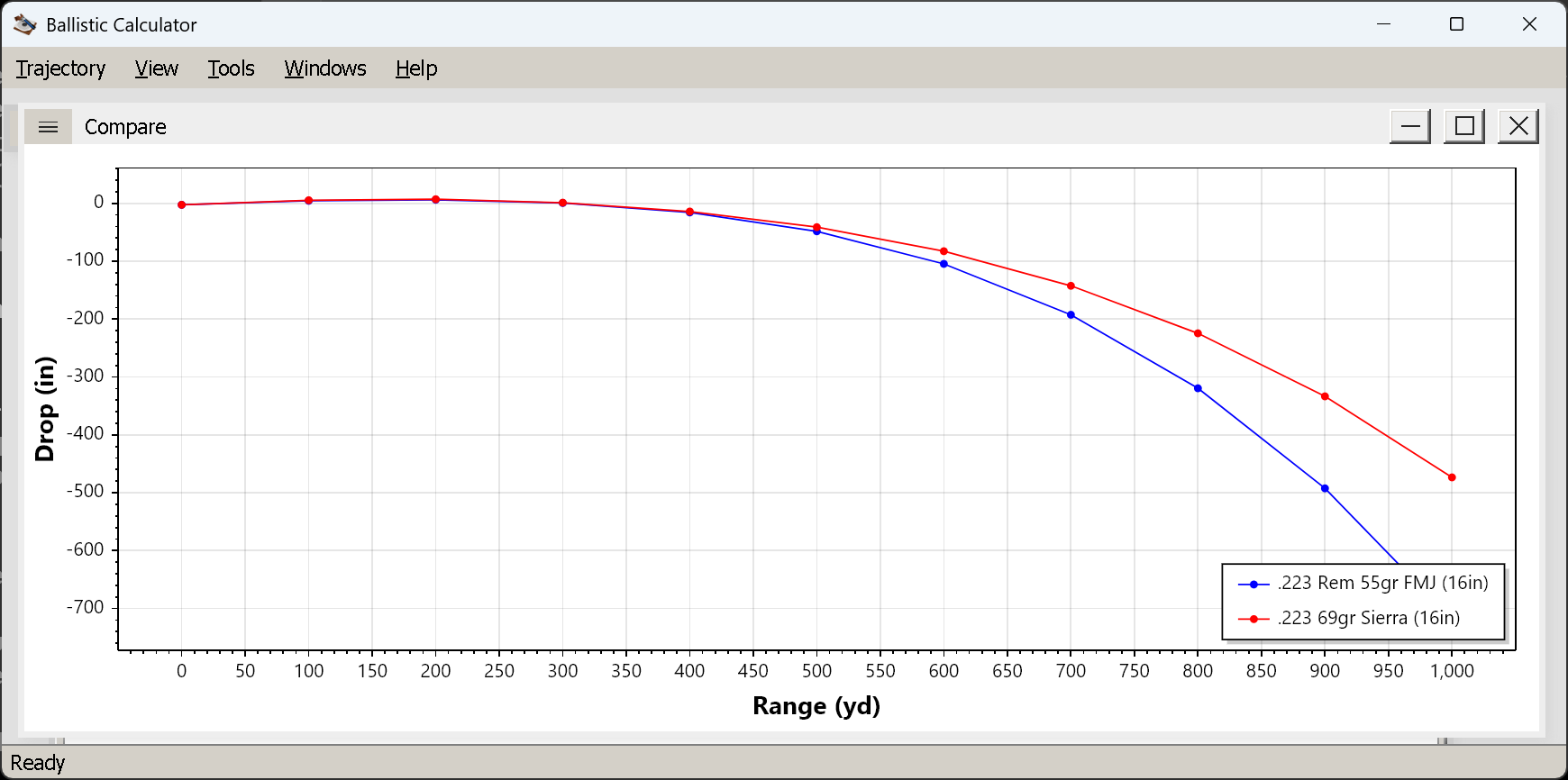 Loads compared |
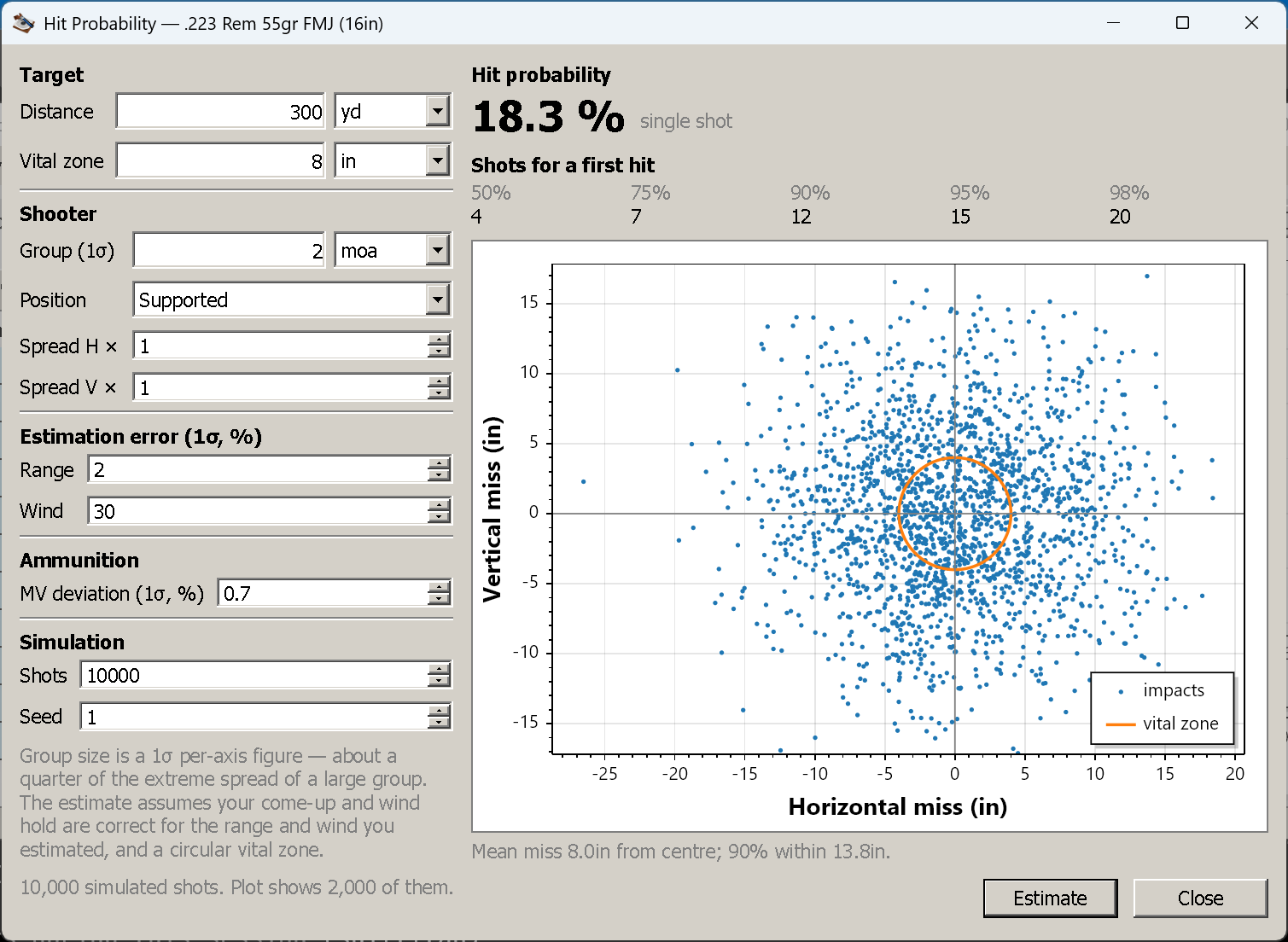 Hit probability |
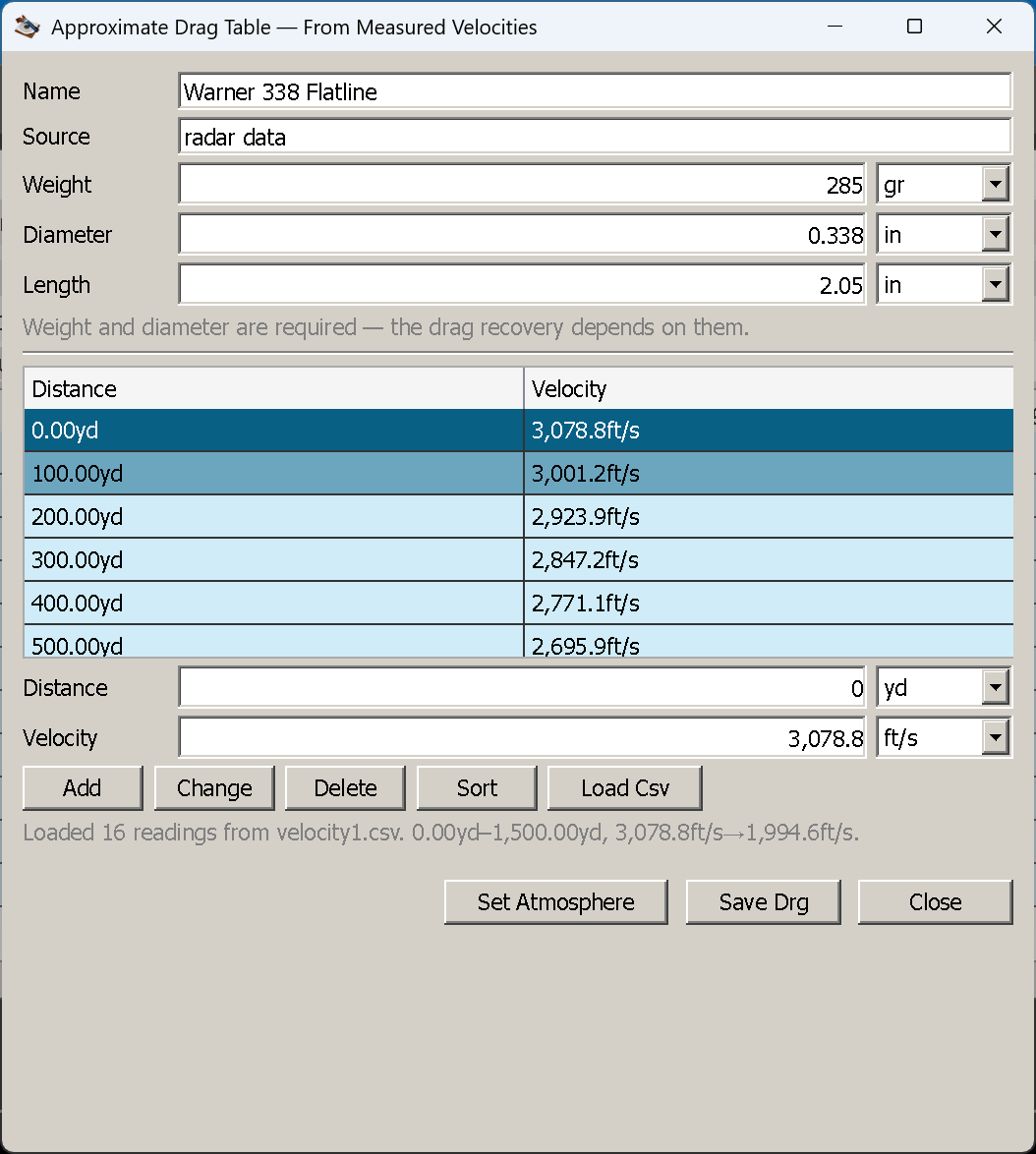 Drag table from radar data |
Trajectory
- 3DOF point-mass integration with spin drift, crosswind aerodynamic jump (Litz / Applied Ballistics) and the Coriolis effect (barrel azimuth plus shooter latitude)
- Uphill and downhill shots, scope cant, and multiple wind zones along the flight path
- Zeroing with a different cartridge, atmosphere or wind than the shot itself — zero supersonic, shoot subsonic
- Results as a table, a chart, and a sight picture through your own reticle; several trajectories can be compared on one chart, and any table exports to CSV
Those correction terms are computed from inputs, not assumed: spin drift and aerodynamic jump need the rifling twist plus the bullet’s diameter and length, and Coriolis needs the barrel azimuth and your latitude. Leave them out and the corresponding term is simply absent — the number you get is the trajectory without it, not an error message.
Drag models
- All the standard curves — G1, G2, G5, G6, G7, G8, GI, GS, RA4
- Custom drag tables (
.drg) — the projectile’s own measured Cd curve - Approximating a drag table you do not have, two ways: from a multi-BC curve (BC quoted at several Mach numbers, as many data sheets do), or from measured downrange velocities (radar or chronograph data)
- Converting a ballistic coefficient between standard tables — the everyday G1 ↔ G7 question, at a reference velocity you choose, with the accuracy caveat stated rather than buried
A library of radar-derived .drg tables for Lapua projectiles ships with the application.
Analysis
- Hit probability — a Monte-Carlo estimate over your error budget: group size, shooting position, range and wind estimation error, and the ammunition’s muzzle-velocity deviation. It reports the single-shot probability, how many shots a first hit needs at 50/75/90/95/98 %, and the impact scatter against the vital zone
- Point-blank range and the dead-zone span, near and far zero, and the distance where the bullet goes subsonic
- Moving-target lead, drawn as an aim-off box on the reticle
Libraries and editors
- An ammunition library, and sight and barrel preset dictionaries, so nothing is typed twice
- A separate reticle editor — build your own reticle from lines, paths, circles, rectangles, text and BDC marks
What it does not do
Worth knowing before you go looking for it:
- No 6DOF or 4DOF angular motion. Nothing about yaw, precession or transonic instability. See the reasoning above.
- No ballistics primer. This guide teaches the application; the physics is left to the literature in Recommended reading.
- No load or reloading data, and nothing about interior ballistics. Muzzle velocity is an input you measure or take from a box, never something the application predicts.
- No online lookup. Bullet data comes from you, from the shipped
.drglibrary, or from a file you supply. Nothing phones home.
Risk notice
The application performs a very limited simulation of a complex physical process and therefore makes a great many approximations. The calculation results MUST NOT be considered as completely and reliably reflecting the actual behaviour or characteristics of projectiles. While these results may be used for educational purposes, they must NOT be considered reliable in any area where an incorrect calculation could lead to a wrong decision, financial harm, or risk to human life.
THE CODE IS PROVIDED “AS IS”, WITHOUT WARRANTY OF ANY KIND, EXPRESS OR IMPLIED, INCLUDING BUT NOT LIMITED TO THE WARRANTIES OF MERCHANTABILITY, FITNESS FOR A PARTICULAR PURPOSE AND NONINFRINGEMENT. IN NO EVENT SHALL THE AUTHORS OR COPYRIGHT HOLDERS BE LIABLE FOR ANY CLAIM, DAMAGES OR OTHER LIABILITY, WHETHER IN AN ACTION OF CONTRACT, TORT OR OTHERWISE, ARISING FROM, OUT OF OR IN CONNECTION WITH THE MATERIALS OR THE USE OR OTHER DEALINGS IN THE MATERIALS.
Licence and source
GNU General Public License v2. Source, releases and the issue tracker are at github.com/nikolaygekht/ballistic.calculator.app.avalonia.
The engine and unit libraries it is built on are separate projects: BallisticCalculator (the trajectory mathematics) and Gehtsoft.Measurements (units and conversions). Both are open source, and the engine is the place to look if you want to check how a number is produced.
Next
Installation and first run — from the Releases archive to a running application, and where it keeps its files.