The Weather tab
Goal of this article: describe the air the bullet flies through, without making the one mistake that quietly ruins a long-range solution — feeding it a sea-level pressure as if it were the pressure where you are standing.
Air is what makes external ballistics hard: denser air means more drag, less velocity, more drop and more wind deflection. Four numbers describe it here, and the tab is one of the five that has a usable default, so you can ignore it entirely on a first run.
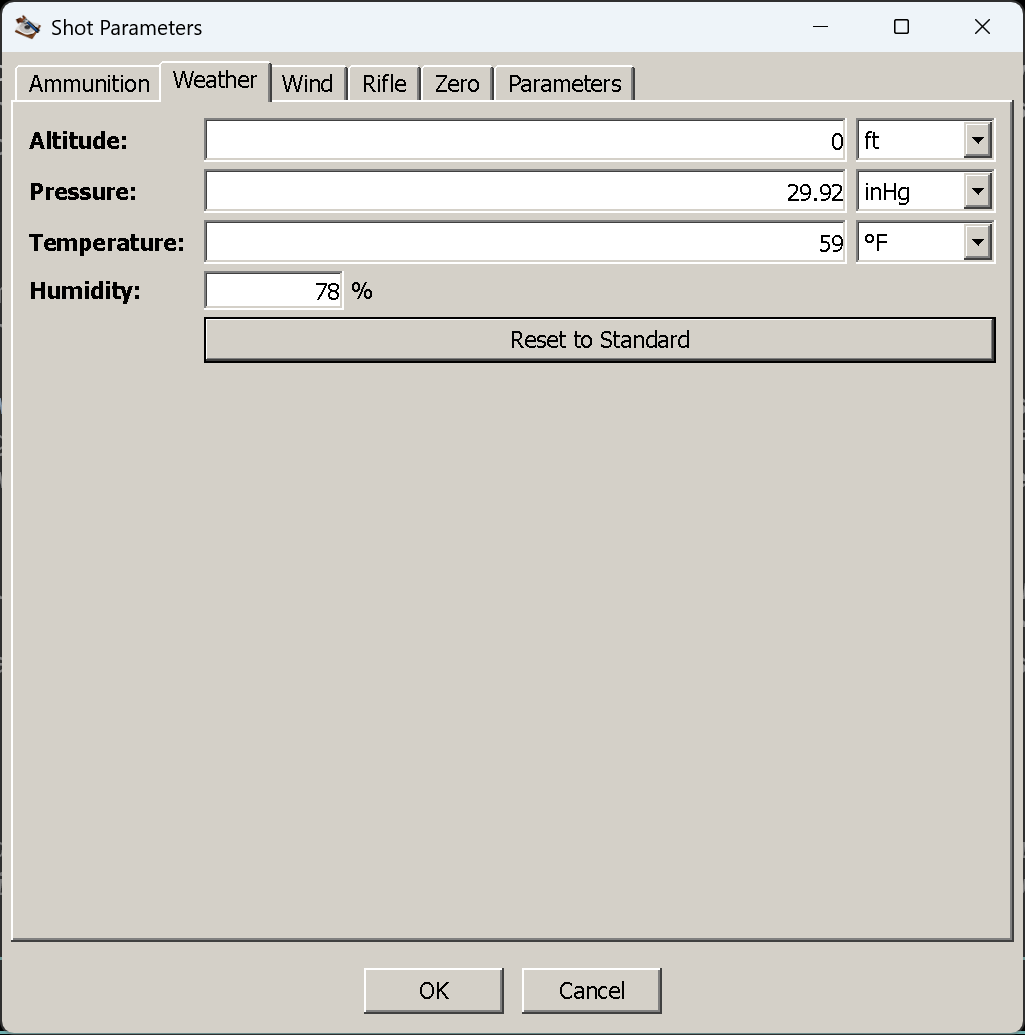
Standard conditions in an imperial window.
The fields
All four are required together: fill in one and you have to fill in all of them, or the dialog will report the tab as incomplete when you press OK. Leave the whole tab alone and it uses the standard atmosphere.
| Field | Imperial | Metric | What it is |
|---|---|---|---|
| Altitude | foot | metre | Your height above sea level — the shooting position, not the target |
| Pressure | inHg | hPa | The air pressure at that altitude. See below; this is the field that catches people |
| Temperature | °F | °C | Air temperature at the shooting position |
| Humidity | % | % | Relative humidity, 0 to 100 |
Reset to Standard fills in the ICAO standard atmosphere: sea level, 29.92 inHg / 1013.2 hPa, 59 °F / 15 °C, 78 % humidity. It is the fastest way to get back to a known baseline after experimenting.
Station pressure, not sea-level pressure
This is the one that matters. The pressure field is the station pressure — the pressure of the air around you, at the altitude you entered. It is not corrected, and the application does not ask whether your figure is corrected.
The trap is that most published pressures are corrected. An aviation altimeter setting (QNH), the “pressure” in a weather app, and the barometric reading on a TV forecast are all normalised to sea level so that they can be compared between places. At 5,000 ft, a sea-level-corrected 29.92 inHg corresponds to roughly 24.9 inHg of real air. Enter the corrected figure with an altitude of 5,000 ft and you have described air about 20 % denser than what you are shooting through — which, at distance, is a miss you cannot explain from the ballistics.
So:
- A Kestrel or any absolute barometer reads station pressure. Enter it as it is.
- A weather report, a phone app or an altimeter setting is almost always sea-level-corrected. Either convert it to station pressure for your altitude, or ignore it and use the standard atmosphere at your altitude instead — which is what the altitude field is for.
Altitude and pressure are not two ways of saying the same thing. Altitude affects the air the bullet meets along the way, and it also feeds the density the solver derives from your pressure and temperature. It is not a substitute for measuring the pressure, and the pressure is not a substitute for telling the application how high you are.
Temperature and humidity
Temperature does two things: it changes air density — cold air is denser, so drag is higher — and it sets the speed of sound, which decides where the transonic region falls. That second effect is why the Mach column in the table moves when you change nothing but the temperature.
Temperature also changes your muzzle velocity, through the propellant rather than the air, and the application does not model that. A load chronographed at 20 °C does not leave the barrel at the same speed at −10 °C. If you know your load’s temperature sensitivity, apply it yourself on the Ammunition tab by entering the muzzle velocity you actually expect on the day.
Humidity is the one number here that barely earns its place. Humid air is very slightly less dense than dry air at the same pressure and temperature, and across the full 0–100 % range the effect on drop is a fraction of what a 5 °C temperature error does. Enter it if you know it; do not go looking for it.
Leaving it empty
If you never open the tab, OK offers you the default and the shot runs in standard sea-level air: 15 °C / 59 °F, 78 % humidity, one atmosphere. That is a legitimate way to work — it is what published ballistic tables assume, and it makes two loads comparable — but it is not your air unless you happen to be at sea level on a mild day.
(A pedantic detail, in case you compare the two: the default’s pressure is 29.95 inHg where Reset to Standard writes the ICAO 29.92 inHg. The difference is 0.1 %, far below anything you could measure or shoot, but it is why the two are not bit-identical.)
Things that catch people out
- A sea-level pressure entered with a real altitude. The single biggest error available on this tab.
- Filling in three fields and not the fourth. The tab is all-or-nothing; OK will say so.
- Expecting a cold-weather velocity drop. The air is modelled, the propellant is not.
- A humidity typed with a comma. The humidity box wants a plain number with a dot if you use decimals; a comma is not accepted, and the tab then reads as incomplete.
Next
The Wind tab — the other half of the air, and the one that moves the bullet sideways.